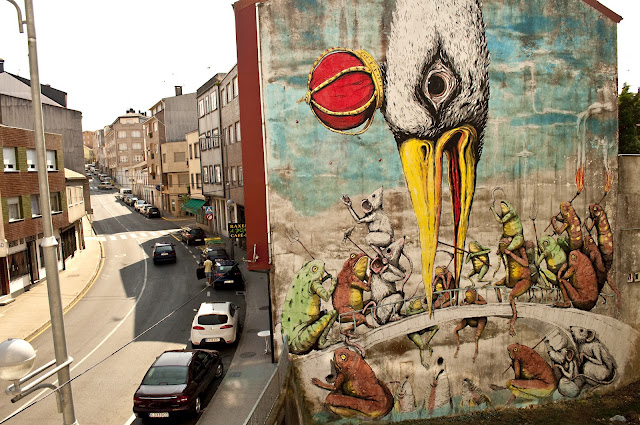
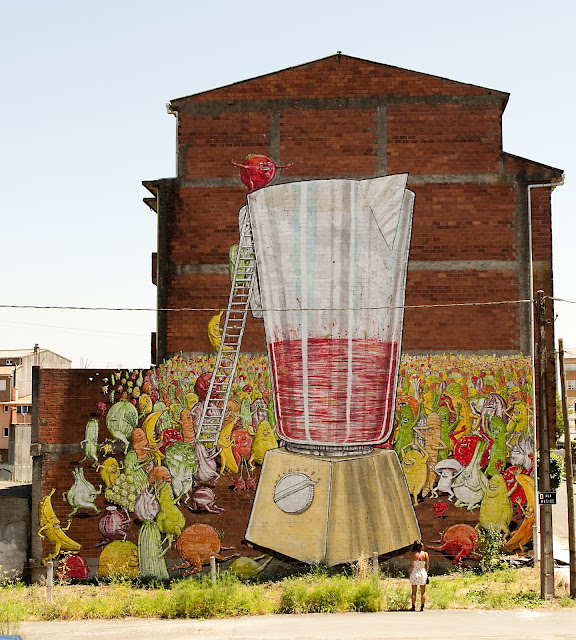
"In the contemporary art scene, Claudia Rogge is an exceptional person.
This is not only because she travelled through Europe alone, in a glass
lorry, but because she presented naked men on their knees, bent forward
and neatly stacked, to amazed passers-by in Brussels, Paris or Munich.
Mass made into shape and a compact installation transportable for
Europe. Art is brought to people. They are confronted with it so that
they can only choose between continuing their way or stopping. Many did
stop and were eager to talk to the artist. Authorities appeared
reasonable, forgot laws and rules and proved themselves curious and
ready to talk." [more bio here] [gallery here]
Labels
- Interesting (64)
- Knowledge (50)
- Quotes (44)
- Art (40)
- Literature (31)
- The Big Move (24)
- Philosophy (21)
- Philadelphia (20)
- Dallas (15)
- Eating Animals (15)
- Religion (13)
- Chicago (11)
- California (10)
- Dubstep (9)
- Progress (5)
- Agnosticism (4)
Showing posts with label Art. Show all posts
Artist: Juan Carlos Paz
"Two years ago I set out on a journey inside my head to document
the local fauna there. These photographs are what I've come back with so
far, thirty three life forms that comprise the core essence of a much
larger family that keeps growing everyday." -- Juan Carlos Paz
Two
years ago I set out on a journey inside my head to document the local
fauna there. These photographs are what I've come back with so far,
thirty three life forms that comprise the core essence of a much larger
family that keeps growing everyday. - See more at:
http://www.faithistorment.com/2013/08/bakelanasland-illustrations-by-juan.html#sthash.eDvH8vq0.dpuf
Two
years ago I set out on a journey inside my head to document the local
fauna there. These photographs are what I've come back with so far,
thirty three life forms that comprise the core essence of a much larger
family that keeps growing everyday. - See more at:
http://www.faithistorment.com/2013/08/bakelanasland-illustrations-by-juan.html#sthash.eDvH8vq0.dpuf
Two
years ago I set out on a journey inside my head to document the local
fauna there. These photographs are what I've come back with so far,
thirty three life forms that comprise the core essence of a much larger
family that keeps growing everyday. - See more at:
http://www.faithistorment.com/2013/08/bakelanasland-illustrations-by-juan.html#sthash.eDvH8vq0.dpuf
Two
years ago I set out on a journey inside my head to document the local
fauna there. These photographs are what I've come back with so far,
thirty three life forms that comprise the core essence of a much larger
family that keeps growing everyday. - See more at:
http://www.faithistorment.com/2013/08/bakelanasland-illustrations-by-juan.html#sthash.eDvH8vq0.dpuf
Two
years ago I set out on a journey inside my head to document the local
fauna there. These photographs are what I've come back with so far,
thirty three life forms that comprise the core essence of a much larger
family that keeps growing everyday. - See more at:
http://www.faithistorment.com/2013/08/bakelanasland-illustrations-by-juan.html#sthash.eDvH8vq0.dpuf
Artist: Trenton Doyle Hancock
This work was favorite from our recent trip to the Fort Worth Museum of Modern Art. As soon as I got home, I went online to find more. It reminds me of Murakami in it's scale, detail, and complexity but beyond that, the similarities stop. It isn't obvious in the above picture, but the pink in the piece is a fuzzy texture. The canvas is hung without matte or frame.

From the notes preceding a lecture given by Hancock at the San Fransisco Art Institute: Trenton Doyle Hancock’s intricate candy-colored prints, drawings, collaged felt paintings, and site-specific installations work together to tell the story of the Mounds—a group of bizarre mythical creatures that are the tragic protagonists of the artist’s unfolding narrative between good and evil.
Influenced equally by the history of painting as by the pulp imagery of pop-culture, Hancock transforms traditionally formal decisions—such as the use of color, language, and pattern—into opportunities to create new characters, develop subplots, and convey symbolic meaning. Hancock’s works are suffused with personal mythology presented at an operatic scale, often reinterpreting Biblical stories that the artist learned as a child from his family and local church community. His exuberant and subversive narratives employ a variety of cultural

From the notes preceding a lecture given by Hancock at the San Fransisco Art Institute: Trenton Doyle Hancock’s intricate candy-colored prints, drawings, collaged felt paintings, and site-specific installations work together to tell the story of the Mounds—a group of bizarre mythical creatures that are the tragic protagonists of the artist’s unfolding narrative between good and evil.
Influenced equally by the history of painting as by the pulp imagery of pop-culture, Hancock transforms traditionally formal decisions—such as the use of color, language, and pattern—into opportunities to create new characters, develop subplots, and convey symbolic meaning. Hancock’s works are suffused with personal mythology presented at an operatic scale, often reinterpreting Biblical stories that the artist learned as a child from his family and local church community. His exuberant and subversive narratives employ a variety of cultural
Thoughts from the Dallas Museum of Art
I wore headphones to the museum today. I didn't waste time on paintings that didn't interest me. The headphones blocked out distracting conversation and the echo of my heals. I spent about 35 minutes wandering around and 20 sitting in a 3rd floor chair that overlooked the crowded street, Klyde Warren Park, and the Sculpture Garden.
Thought 1: Within a gallery, everything in view is created. Many museums are works of art themselves. The choice of font and color used in the "out on loan" post card left in place of a display item is a creation. The display cubes and colors are similarly, a creation. What art is and isn't is the topic of many books, but to really see that there is very little difference between art objects and intentionally created none-art objects is a great experience.
Thought 2: Before photography, paintings must have been amazing. How else could one see a place second-hand like the ocean, a jungle, or the mountains and really understand? I imagine people who had never seen the ocean crowding around a painting of it. With photography, painters are still admired for their skill, but what function do they fulfill for viewers unless the image is altered in a surreal or abstract way?
Thought 3: Most artwork comes from the minds of a small group of people. Even a movie, comprised of hundreds or more inputs is still miniscule compared to the art of life-- the view from the window. This is one reason artists must "steal" from reality and why the best works of fiction and fantasy take decades to create. The decades of manpower behind the single perspective shown in an in-depth fantasy movie are matched in seconds on the street.
Thought 4: Combining these thoughts, I realized that everything in view from the window was in art piece created from the wills of hundreds of artists. The corporate skyscrapers; the sculpted park, planned to the last shrub; the pedestrians' choice of outfit, the outfits themselves created by designers. These were moments of art more complex than any in the museum and they would never be recreated.
Why then do we need museums? I think it's the same reason we need designated art. For the frame. The museum building itself acts as a frame and says, "Look at me, I'm an important aspect of society. You can come here, look out the window, and think about art." Ideas like the above ensue.
Maybe we'll eventually move beyond this.
Reluctant Chauffeur: Thoughts from the Philadelphia Museum of Art
**The above painting is "Calle de Gabino Barreda", by Gunther Gerzso, one of my favorites from the Dallas Museum of Art.**
Art: Seven works of art from high-school and earlier
I was looking through a backup hard drive recently and found these images from high-school and earlier. I know I wasn't very skilled and some of the concepts are heavy-handed, but having made them myself, I still find myself attached. My short-lived life as a visual artist:
Pencil sketches, scanned and computer colored.
Art: Graffiti links and pictures from Philadelphia's Italian Market
I'll eventually get around to researching and posting on the art, psychology, and social aspects of graffiti. In the meantime, here are some pictures I took in Philadelphia's Italian Market area and links to some recent online favorites.
1. Banksy's Miami Art Exhibit shows how accepted it's become -- check out Banksy's documentary Antics Roadshow on Neflix.
2. Fall Graffiti Roundup from Arrested Motion
3. Philadelphia Italian Market Area:
Thoughts from the Philadelphia Museum of Art
If you listen to art museum conversation, you'll hear all different attitudes echoing from the gallery walls. Some are awed by the skill it takes to
create while others like the history and story shown in the art. Some treat modern art like a riddle to be decoded while others gawk as if they're at a freak show. We go to to impress a date or prove to ourselves that we're cultured. We go because we're seven and our parents dragged us here on a field trip.
I've gone to art museums for all these reasons, but currently I go because art inspires ideas and gets me out of the house. I like pieces that relate to and expand my perceptions and appreciations.
I find art to be reflective. It's often more dependant on the character of the person experiencing it than the art itself. The more open, intelligent, and knowledgeable someone is, the higher potential to enjoy or benefit from a museum.
Next time I go, I think I'll bring blinders and earplugs so I can focus more on the art and less on the people.
Here are three of my favorites from a recent visit to the Philadelphia Museum of Art:
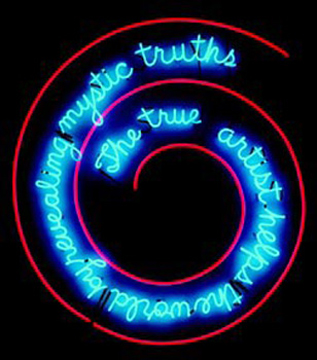
1. This piece by Bruce Nauman, "The True Artist Helps the World by Revealing Mystic Truth" addresses the crowd who is quick to dismiss modern art with a disapproving, "I could have done that." by stating the function of art in an artwork that simultaneously fulfills the function.
2. This one, by Jasper John, "Memory Piece (Frank O'Hara)", speaks of our transitory nature and
I've gone to art museums for all these reasons, but currently I go because art inspires ideas and gets me out of the house. I like pieces that relate to and expand my perceptions and appreciations.
I find art to be reflective. It's often more dependant on the character of the person experiencing it than the art itself. The more open, intelligent, and knowledgeable someone is, the higher potential to enjoy or benefit from a museum.
Next time I go, I think I'll bring blinders and earplugs so I can focus more on the art and less on the people.
Here are three of my favorites from a recent visit to the Philadelphia Museum of Art:
1. This piece by Bruce Nauman, "The True Artist Helps the World by Revealing Mystic Truth" addresses the crowd who is quick to dismiss modern art with a disapproving, "I could have done that." by stating the function of art in an artwork that simultaneously fulfills the function.
2. This one, by Jasper John, "Memory Piece (Frank O'Hara)", speaks of our transitory nature and
Quick Quotes 25: Art
An artist cannot fail; it is a success to be one.
--Charles Horton Cooley
Art is the proper task of life.
--Friedrich Nietzsche
Art is not a thing; it is a way.
--Elbert Hubbard
Artist: Henrik Vibskov
"Henrik Vibskov's work is considered part of the "New Nordic Movement", a term to describe 21st century design in various media as practiced by designers from Northern European countries." (Wikipedia)
Art: Barbara Kruger Aug 20th at Hirschorn
Art: Palindromo Meszaros
This photograph by Palindromo Meszaros is not Photoshopped. The color on the trees is from a toxic waste spill in 2010.
Artist: Takashi Murakami
Ever since I saw Marakami's work in the Frankfurt Museum of Modern Art, I've been wanting more. The exhibit I saw was a full museum conversion. Marakami's huge canvases and sculptures filled out the large rooms. Sculptures hung from the ceilings and some of his patterns for Louis Vuitton decorated the walls like wallpaper. Clips of the video he directed for Kanye West "Good Morning" were playing in a special theater. Internet pictures don't do justice considering the dimensions and detail of his work. He generally shows in larger cities. Consider going if you're into this type of art and have the opportunity.
From Wired Magazine:
"Takashi Murakami is often billed as the next Andy Warhol. Like the American pop art icon, he fuses high and low, pulling imagery from consumer culture to produce visually arresting, highly original work. He is vigorously, ingeniously self-promotional. In the past few years,
Artist: Frieke Janssen
"Adult
smokers are the societal norm, so I wanted to isolate the viewer’s focus
upon the issue of smoking itself. I felt that children smoking would
have a surreal impact upon the viewer and compel them to truly see the
acts of smoking rather than making assumptions about the person doing
the act."
Artist: Ben Robinson
This is one of my sister's friends. She recommended him and showed me a few of his pieces when I was visiting a couple weeks ago. Without doing anyone any favors, his surreal art is definitely worth looking into.
"War" by Ben Robinson
"Make Your Own Reality" by Ben Robinson
Artist: Martin Wittfooth
Saints Preserve Us by Martin Wittfooth
The Sacrifice by Martin Wittfooth
Sebastion by Martin Wittfooth
"Wittfooth’s oil paintings explore disquieting themes of industry and
nature, unhinged evolution, the clash of old ideologies with modern
fears, and the growing shadow of the human footprint on the earth."
Fun: A post in tribute to forts
There is something exciting about forts. While houses and other buildings do protect from outside dangers, they generally have other primary purposes. Forts exist only to defend and protect. They create a barrier between the outside and the inside allowing for a world within a world. They have selective membership. They use the environment to their advantage.
The forts we built as children had a similar purpose. They served to create the temporary fantasy of a house all our own where we were in charge, and the outside world could be forgotten. The process of building the fort was the building of the fantasy. Nothing had to be realistic or practical. Unlike military forts, childhood forts could be create and dismantled in a day.
This is a post in tribute to forts:
Top 10 Ancient Forts Around the World
Top 10 U.S. Forts
Awesome Collection of Crazy Forts
10 Amazing Tree Houses
From what I remember of childhood fort building, there were a number of types and styles. An improvised couch cushion fort on a rainy day was very different from the shed attic used as a permanent fort all summer.
Here are the forts I remember creating as a child--
1. Adopted Forts (All these forts required was moving in):
Attic Fort
Crawl Space Fort
Above the Garage Fort
Under the Table Fort
Shed Fort
Tents
Camper in the Backyard Fort
Playground Fort
2. Nature Forts:
Snow Igloo
Tree Fort
Bush Fort
3. Forts by Design (These forts involved some construction):
Box Fort
Couch Cushion Fort
Mattress Fort
Umbrella Fort
Box Fan and Blanket Fort -- I thought I inventedthis idea but here is a link to instructions.
Clothesline Fort
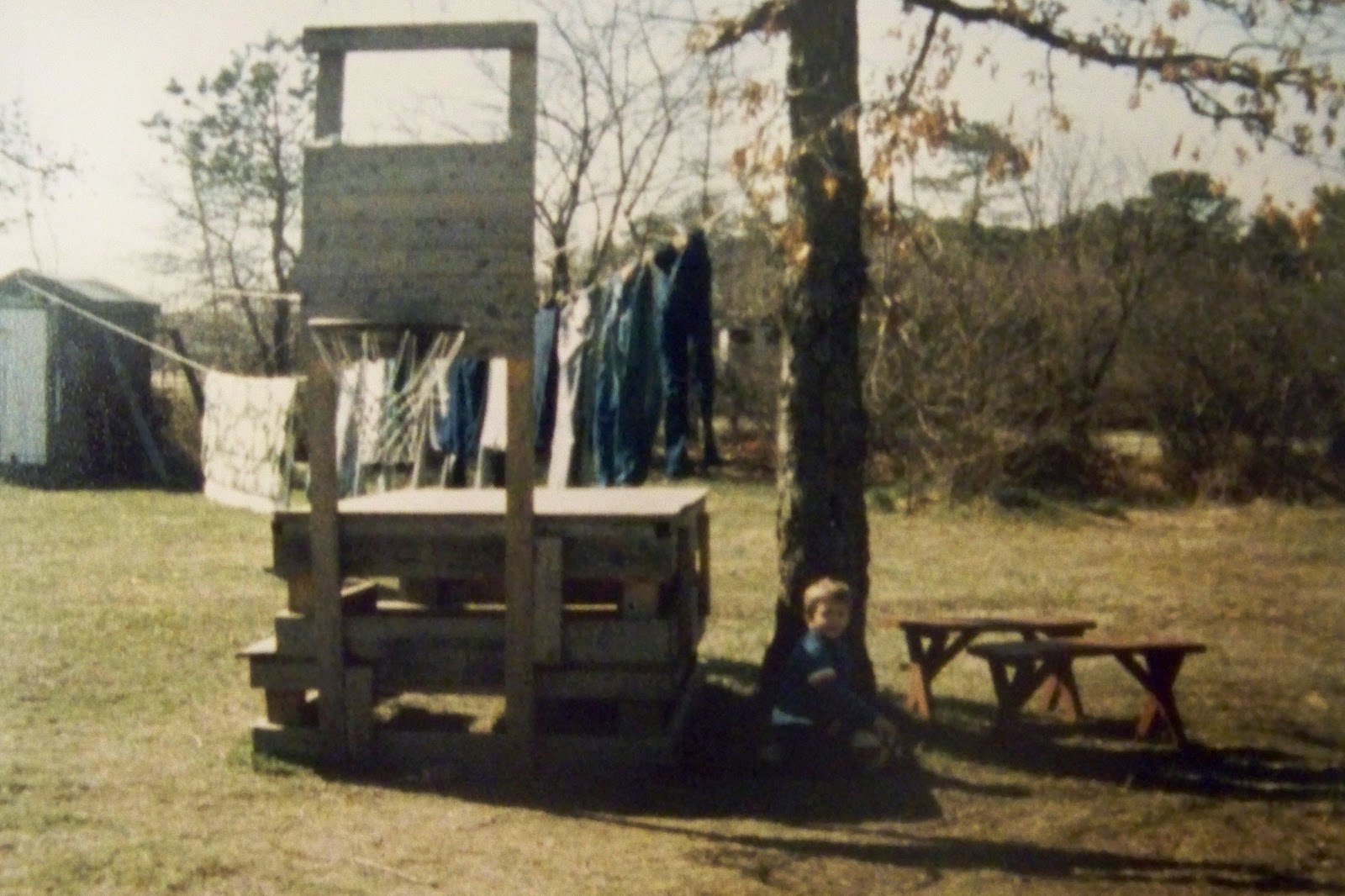
Dad's Extra Lumber Fort
Subscribe to:
Posts (Atom)