Labels

Showing posts with label Favorite. Show all posts

Woman Has Baby!: Why it shouldn't matter that the Royal Family doesn't matter

I'm a few days late on this one, but it's been a busy week!

Monday, I was in the vicinity of a television airing the "breaking coverage" of Prince George's birth and realized that I've moved beyond not caring. I no longer even care about not caring.

I'm not trying to make a competition out of how apathetic I can be about the royal family. I've just realized that maybe this is a way to stop the onslaught of coverage. Think about it. The reason these types of stories get so much coverage isn't only because a lot of people care. It's because a lot of people enjoy pointing out the ridiculousness of the people who do care. 

If you look closely, many stories have an underpinning of mockery as they show the candles, cakes, and roadside vigils. The newspaper here in Chicago featured a second generation royal family devotee who was congratulated on Facebook as if she was the one who gave birth. How many people watching the news identify with people like this woman, and how many just want to feel superior by realizing how silly and hollow this type of behavior is? I'd wager most, especially in America, feel the latter. Either way, it's great for the news channels who can cover the story ambiguously and appeal to both camps.

There are always going to be people who care deeply about things things that lack the importance for widespread coverage or debate. There are always going to be people who care if the royal baby's first car seat was improperly secured. Let them. There is an American Girl Doll store by us on Michigan Ave. I've walked by and seen adult woman carrying their dolls into the store to buy new

Thoughts inspired by Larry Wachowsky's sex change

By Tyler Samien
As posted on WhenFallsTheColiseum

Recently, I saw a post on Facebook from someone who had learned of Osama Bin Laden’s assassination an entire year after it happened. As a well informed American, he was shocked that he had initially missed the story.  I’ve never missed news as big as Bin Laden’s death (as far as I know), but I can relate. I was just as shocked when I learned recently from a New Yorker article on the upcoming Cloud Atlas Movie  that the Wachowski Brothers are now the Wachowski Siblings and Larry is now Lana.

What concerned me on learning about the “siblings” was not the news (who really cares?), it was the thought that I may be out of touch.  Supposedly, the big news on Lana was in 2008, I was way behind. I was forced to justify my ignorance by either (1) convincing myself that I should be proud of my chosen news sources for withholding such frivolity or (2) convincing myself that the daily proliferation of ever-changing information means everyone (you included) will eventually miss something important. I chose the latter.


Hopefully you don’t choose the day Osama Bin Laden is killed to go overnight camping in a wilderness without cell service and spend the week after in a self-loathing pit of media avoidance and drunkenness due to a breakup, but it could happen. As a child, you could miss the bus the morning you were supposed to learn what a BJ is and decades later, be mocked for your ignorance at work.
How does it feel to know that there are probably obvious things you don’t know that everyone else does? That these things may be waiting to surprise you when you least expect it? Depending on your personality, the thought can be scary or fun. It reminds of something that happened to my sister recently.  [Read More]

The shoulders of giants: exponential knowledge and the internet


Whenever I think I have a good idea, writing or otherwise, I've made it a habit to search the internet before continuing. I run it through Google using multiple variations and phrasings of the idea and, as expected, many of my ideas have already been had; often times in a better or more developed form than mine. The truth is humbling.

I do this for reasons other than grounding my ego. Mainly, it allows me to get from point A to point D in the time it would normally take me to get to point B only. Once at point D, I can then decide if I want to add my own thoughts and possibly take the discussion to point E or take a few steps back and develop D v2.0. In the past, people could stay at points A and B thinking they had a unique and developed perspective, but that's no longer the case. Technology and, more importantly, knowledge in all fields is growing rapidly and

Developments in the moral guidance of mainstream comedy

With the rise of comedians like Louis C.K. and Bill Hicks the complexity of comedy is increasing. Comedy is no longer three idiots poking one another in the eye and farting. It's no longer even just an irreverent and humorous dismantling. As religious explanations fall further and further behind the evolutions of society, comedians have stepped in to fill the gap. Comedians are the new preachers, comedy clubs are their churches, and the audience members that understands it are the frustrated moral progressives.

Comedy has always been used to influence opinion. Satire and wit serve to exhibit intelligence and bolster respect for the comedian. A jaded discontent on the part of a comedian taps into the restlessness of youth and challenges flawed power structures. In exchange for being receptive, audiences receive a laugh, and a pleasurable listening experience. It's a powerful medium for information delivery.

This form of delivery has most often been used to poke fun and reveal the ridiculousness of behaviors, traditions, and social mores. In short, comedy improves society by breaking it down. Comedies like George Carlin mock religion, Lewis Black pokes fun at politicians, and Jim Gaffigan gets a chuckle from the horrors of food addiction. Until recently, moral guidance has been left to its traditional sources: religion and its ministers. Things are changing.

Analysis of life, healthy doses of fatherly advice, and exploratory spiritual sketches on the meaning of life are among the newest developments. Unlike traditional moral guidance, behavior and language are shallow indicators of moral principle. Comedians understand this with their colorful language and perverse descriptions. This seems to be in line with the realizations of many liberated ex-religious. Leave puritanism to fossilized Quakers and Christians who, without the 10 commandments would apparently forget how to behave and eat each other alive. Purity and wellness are not as simple as doing and saying the right things. Like this post, many comedy sketches are just vague attempts at progress; abstracts, but who really has the answers anyway?


Bill Hicks:

"The world is like a ride in an amusement park, and when you choose to go on it you think it's real because that's how powerful our minds are. The ride goes up and down, around and around, it has thrills and chills, and it's very brightly colored, and it's very loud, and it's fun for a while. Many people have been on the ride a long time, and they begin to wonder, "Hey, is this real, or is this just a ride?" And other people have remembered, and they come back to us and say, "Hey, don't worry; don't be afraid, ever, because this is just a ride." And we … kill those people. "Shut him up! I've got a lot invested in this ride, shut him up! Look at my furrows of worry, look at my big bank account, and my family. This has to be real." It's just a ride. But we always kill the good guys who try and tell us that, you ever notice that? And let the demons run amok … But it doesn't matter, because it's just a ride. And we can change it any time we want. It's only a choice. No effort, no work, no job, no savings of money. Just a simple choice, right now, between fear and love. The eyes of fear want you to put bigger locks on your doors, buy guns, close yourself off. The eyes of love instead see all of us as one. Here's what we can do to change the world, right now, to a better ride. Take all that money we spend on weapons and defenses each year and instead spend it feeding and clothing and educating the poor of the world, which it would pay for many times over, not one human being excluded, and we could explore space, together, both inner and outer, forever, in peace."

Louis C.K.:
"I'm bored" is a useless thing to say. You live in a great, big, vast world that you've seen none percent of. And even the inside of your own mind is endless. It goes on forever inwardly. Do you understand? Being the fact that you're alive is amazing, you don't get to be bored."

[On suicide]
"I got my reasons to live, I've worked to figure out what they are, and I'm not just handing them over to you.... If you wanna tap out 'cuz your life is sh*t, ya know what, it's not your life, it's life ... Life is bigger than you, if you can imagine that. Life isn't something that you possess, it's something that you take part in."


[On work and fulfillment]


What are some of your favorite comedian quotes?

Labels and signs take away from the experience

 On a recent vacation to New England, my wife and I visited Purgatory Chasm in nearby Massachusetts. Without degrading the experience or beautiful and interesting landscape (see pictures left) I couldn't help but think about the human/land interaction I saw around us.

The first thought involved that of site establishment and labeling. When I was younger, I would spend weeks working at a summer camp in the Catskills. During free time, I would break the rules and leave the camp with friends, striking out across the mountain wilderness. The Catskills were full of cliffs, caves, and rocks, more pronounced than that offered at Purgatory Chasm and other sites having official names, maps, and picnic areas. Sites that are official are often created based on economics, demand, and availability and named to attract attention and interest rather than being particularly unique. What is the effect of hyping nature in this manner? Why did a small nook created by falling boulder have to be called "Devil's Crib" instead of "A little nook under a rock". Why note it at all? The result is an enhanced experience at the cost of a twisted reality and influenced perception.

The second thought on this issue is one that often comes up in postmodern studies relating to representation. Any location has multiple existences: The true place as it actually is, the place as it is interpreted by individuals experiencing it, and the place as it comes to exist in view of a society or group.

The first existence is unknown to us do to the limits of our senses. The second existence is what we create in our minds depending on what part of the place we see, from what angles, and what is going on in the place at the time we are there (weather, crowd, time of day). The third existence is a combination of second existences along with evolutions created by photography, conversation, and writing. People who have never been to the Eiffel Tower, for example, have a sense of the place that will be entirely shattered once they actually visit it. A similar existence is shared by many people who have never been to the Eiffel Tower due to photographs and movies.

The difference between second and third existences is most evident to those who have had the opportunity to travel to many of these sites. My first experience was with the Sacre Coeur in Paris. The Sacre Coeur presents an image of religiously inspired strength and solidity, but the reality is an amusement park line, noise and crowded masses of tours. It is targeted by hosts of peddlers. As people worship, a shuffling line of tourists moves much like at an amusement park. It was depressing. I've experienced similar at popular sites around the world. If tourists were honest, they would admit how many of the popular sites were miserable to attend. Most however, won't be honest because they either don't want to admit they were hustled and are afraid to admit the emperor has no clothes, or are just so overwhelmed at being somewhere so often talked about and pictured that they don't care how miserable it is. These people have accepted the third existence to such an extent that they disregard reality. Here are a few comparisons as examples.


The importance of belief

As people, our actions are most often no more than responses to our beliefs. Consider how differently you would act if you believed differently, if you believed everyone around was a robot set on your destruction or you were allergic to plastic. We feel as though we choose our actions, yet very few of us act counter to what we believe. Likewise, emotions are dependent on belief. If you believed, for example, that god chose to kill people as a reward and that mourning their death was wrong, you would hardly feel sad when a friend died and might even wish for such things.

For this reason, guarding and honestly defining belief is one of the most important tasks we undertake. Governments, religions, corporations, and others will fight to control this belief but we are born with the tools to sort through the information.

What do you believe and why do you believe it? Anyone who lives their entire life under the beliefs they were handed as a child without questioning is forfeiting what makes them human.

Start at the beginning. You're born with a brain that interprets the world around you. You think. What else do you really know for sure and why? If you decide to accept something on faith, why are you doing so? Through the internet and inexpensive transportation/delivery we have access to experience and knowledge like never before. Take advantage of it to be someone like never before.

Opinion: Truth and Lies are not opposites

Dividing truth and lie into opposite categories simplifies things, but it encourages us to miss the bigger reality. Think about it, the two aren't opposites at all. Truth is discovered while lies are created. Once a lie is created, its existence becomes part of the truth (that which is). There are not multiple truths but multiple perspectives and opinions on what is true. There can be many lies. Truth can rarely be perfectly ascertained while a lie is as simple as its creator. Truth is overarching and factual like a tree or a rock or the existence of a lie. Truth is a concept of the way things are while a lies are just one of the many things that are part of the truth.

Our language and perspectives are rife with similarly flawed categories and divisions that are harmful to our intellect and understanding. Some of these misconceptions are large and contribute to religious systems and social movements. They allow for the persuasion and conviction of the unaware or incapable. The smaller errors are built upon and infect the whole.

This situation we're in as a collective reminds me of a long-term relationship gone bad. After so many years of small behaviors and habits leading away from the necessary path, the members are left wandering. It would often take another lifetime of reflection and contemplation to backtrack and correct. Usually a couple must choose between brushing over the issues or starting over again elsewhere.

Love and hate are similar. They're on opposite sides of the feel good scale, they're also strong emotions that involve being consumed with the subject, but apathy is a more appropriate opposite to love.

Fun: A post in tribute to forts


There is something exciting about forts. While houses and other buildings do protect from outside dangers, they generally have other primary purposes. Forts exist only to defend and protect. They create a barrier between the outside and the inside allowing for a world within a world. They have selective membership. They use the environment to their advantage.

The forts we built as children had a similar purpose. They served to create the temporary fantasy of a house all our own where we were in charge, and the outside world could be forgotten. The process of building the fort was the building of the fantasy. Nothing had to be realistic or practical. Unlike military forts, childhood forts could be create and dismantled in a day.

This is a post in tribute to forts:

Top 10 Ancient Forts Around the World

Top 10 U.S. Forts

Awesome Collection of Crazy Forts

10 Amazing Tree Houses

From what I remember of childhood fort building, there were a number of types and styles. An improvised couch cushion fort on a rainy day was very different from the shed attic used as a permanent fort all summer.

Here are the forts I remember creating as a child--

1. Adopted Forts (All these forts required was moving in):

Attic Fort
Crawl Space Fort
Above the Garage Fort
Under the Table Fort
Shed Fort
Tents

Camper in the Backyard Fort
Playground Fort


2. Nature Forts:

  Snow Igloo
 Tree Fort
Bush Fort


3. Forts by Design (These forts involved some construction):

Box Fort
Couch Cushion Fort
Mattress Fort
Umbrella Fort
Box Fan and Blanket Fort -- I thought I inventedthis idea but here is a link to instructions.
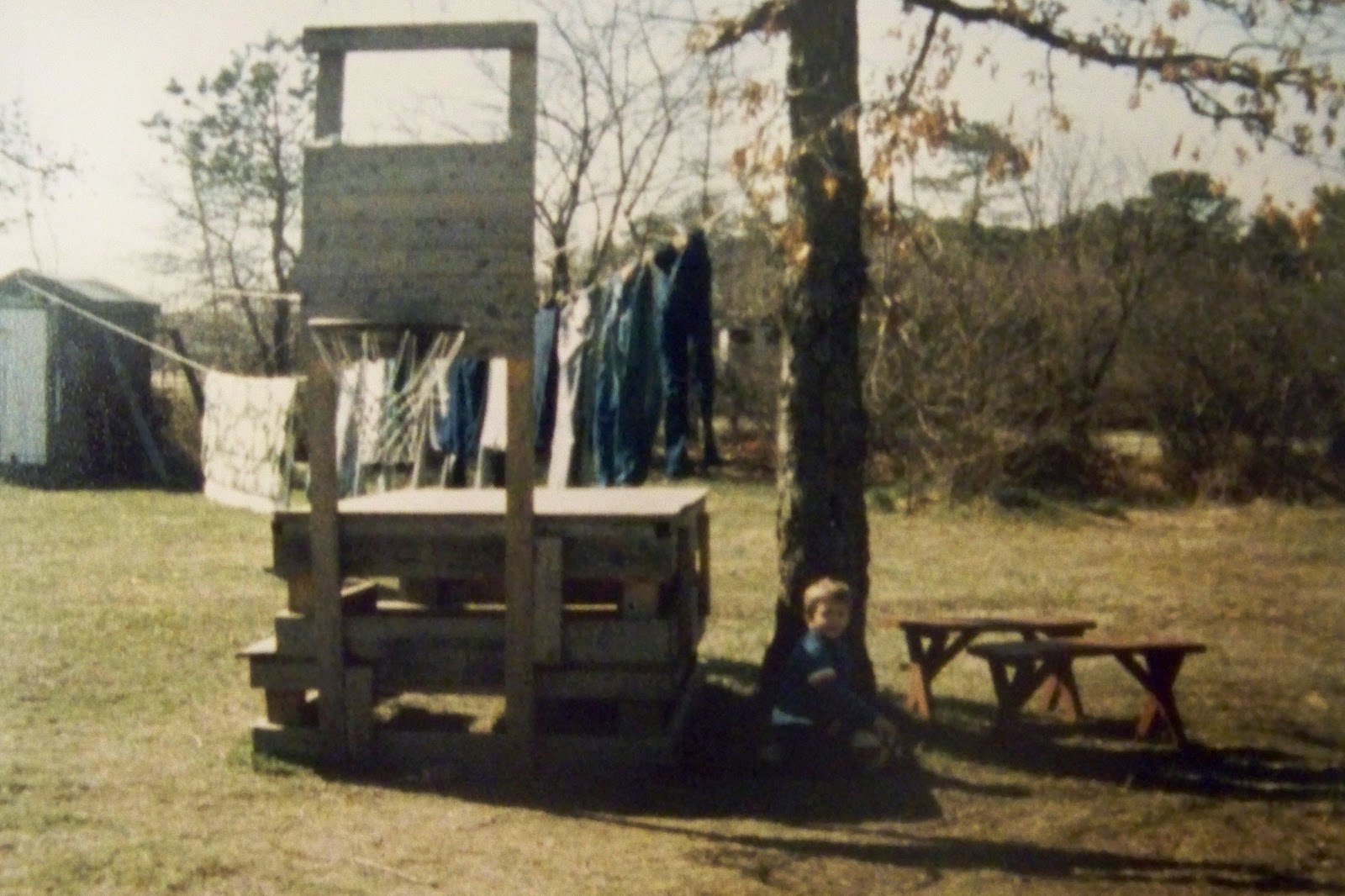
Clothesline Fort
Dad's Extra Lumber Fort


Tipping: Why cabbies and not pilots?

After an abnormally cheerful take-off announcement and a smooth landing on an early morning flight from Knoxville to Chicago, I couldn’t help but wonder: why do we tip certain professions and not others? Why hairdressers and not auto mechanics? Why appliance delivery and not UPS? Why tour guides, bellhops, valet parking, bathroom attendants, and not grocery baggers, librarians, bank tellers, or movie store clerks? Why taxi drivers and waiters but not pilots and flight attendants? [Read the rest here]

Another 10 words and phrases I am asking everyone to stop using in my presence

1. Guestimate
Example Usage: I’d guestimate her bride-price to be at around 8 cows.
Complaint: I’ll let it slide if you’re using it to mock moral stories that involve trading women for cows, but for those of you who are serious— please refrain in my presence or we can no longer be friends.
Annoyance Value: 8

2. Broad Daylight
Example Usage: The police officer threatened people on the street in broad daylight with a firearm because his Hummer was hit by snowballs.
Complaint: As opposed to narrow daylight?
AV:4

3. Expresso
Example Usage: I would like a Venti Peppermint Mocha Expresso with whipped cream, stat!
Complaint: My rant at people who confuse expresso with espresso is temporarily suppressed due to an overwhelming craving for a Peppermint Mocha, but the word is espresso, folks. ESSSSSpresso
AV: 9

4. Touch Base
Example Usage: Hey Milton, I’ll touch base with you later to go over the PTL numbers.
Complaint: It almost sounds dirty. Say “talk” or “contact” instead or, once again, we can no longer be friends.
AV: 6

5. What do you say? (as a greeting)
Example Usage: What do you say Jim Bob?
Complaint: This is something you say to a child after he/she has failed to say thank-you, not a greeting. When I hear this it makes me feel I’m being reprimanded for not saying “hello” fast enough.
AV: 8

6. Weird
Example Usage: He’s just weird. He gives me hateful looks every time I order expresso.
Complaint: The word itself doesn’t bother me, it’s the people who use it in place of what they actual intend or worse, as vague judgment. More often than not, the word reveals a speaker’s comfort level, sensitivity, and lack of cultural understanding.
AV: 5

Read the rest here...

Towards A “Non-Moral” Standard Of Ethical Evaluation

What began as an evaluation of Haidt's opinion on morality and Burqa regulation in France on website Camels With Hammers, has evolved into a discussion between myself and long-time friend and Camels with Hammers site owner, Dan Fincke, on possible ways to evaluate moral systems. Can impartial logic determine what moral or ethical system is best? Ultimately, is there such a thing as "better" when it comes to traditional moral systems?

Below is an excerpt followed by a link to the full discussion:
I think Tyler and I are quite close in our thinking here. I think that when Tyler defines morality as “the judgment of human character” and its identifies the key criterion by which to judge human character to be “what is human excellence,” he is agreeing more with me and with the traidtions of Aristotle, Nietzsche, and (most recently) Thomas Hurka and not necessarily with Jonathan Haidt.
Here’s why. There is a difference between holding morality to be a good unto itself on the one hand and on the other hand to see it as inherently instrumental to our flourishing and as only partially constitutive of our fundamental ethical good. In other words, you can define morality in such a way that its interests do not necessarily line up with our material success or our excellence in all our powers. For example, one might conceive of morality as Kant does, whereby morality is narrowly defined as being concerned only with our autonomy, rationality, and our ability to have a dutiful will that does the good only because it is the good. For Kant, we act morally as long as we sufficiently realize our rational nature. And realizing our rational nature in actions means only that we act according to principles which we could consistently recommend that every other rational agent follow as well.
Read more with my latest comment

What does your refrigerator say about you?

I came across these photographs of the contents of peoples' refrigerators by Mark Menjivar. They're more fascinating than they sound. What a person buys and consumes says a lot about them. In most cases, more than just how healthy he/she is. One of the freezers has a frozen rattlesnake in it!

After seeing the above link, just for fun, without cleaning or straightening anything, I took a picture of my fridge (then cleaned it!). No rattlesnake, but I can say I'm proud of the contents, my half anyway; the fruits and veggies, freshly made iced tea, live, active culture yogurt, top quality eggs. My roommate, Ben's, half had 3 containers of cream cheese. I couldn't decide if he'd just forgotten he already had cream cheese (two were open) or if he just really likes cream cheese.

Ben's side also had two really nasty, rotten oranges, but they weren't his. He thought they were mine, I thought they were his. A closer look revealed they were bought at a produce shop in NJ. Did someone leave oranges in my fridge in the bottom right drawer? You need to come get them, they smell. Thanks!


What does your refrigerator say about you?

F-111 Aardvark

by A.B. Samien

Like that time I came home to find slugs
in the shade of mama's concrete steps,
dressed in uniform,
with little American flags,
burning, coated in salt.

like "Eighteen today, dead tomorrow,"
like "Draft Beer, not boys,"
"Fight the VD, Not the VC."

like the time I flew up the green mountainside
looking down to see my shadow so small,
a cross on the ground
so distant, like your rearview rosary
that night I followed you
because I wanted you back,

and found so much more.
Like clearing that green-topped ridge and
seeing it,
to pull the drop right on and watch
the melting villages with their upturned faces.

Like the old house I bought
with all the decaying bones of once beloved
laid to rest in tissue boxes littered feet below,
dog and cat, fish and rat, mouse, hamster and snake
all since replaced.

You had promised me you'd wait
and you meant it then.
but, yea, it was such a long time.
and no, you aren't making me feel any better
but I'll say you did.

Felt like walking to the edge of the pier, leaning forward,
and dropping my alarm clock from both hands.
Like sinking ringing to where light is dark
and dark is a vacuum ballad,
until my lungs burn fluid and
all I breathe sings truth.

------------------------------------------------------------------------------------------------
The F-111 was used by the US Air Force beginning in 1967. F-111s were used by the Air Force for tactical bombing in Vietnam. It was unofficially known as the “aardvark” until its retirement ceremony in 1996 when the name became official.