Labels

Showing posts with label Knowledge. Show all posts

Interesting: Game Theory links


With the release of the Dark Knight came all types of correlations between Game Theory and the characters. One of the most interesting was published in the Journal of Theoretical Biology and said that the Joker was the real good guy because he benefited Gotham more than anyone.


In a recent article in the Journal of Theoretical Biology, two mathematicians and a physicist use a mathematical model show how the "destructive agents" (which they aptly call "Jokers") can help people avoid the tragedy of the commons. What's the tragedy of the the commons? It's when people try to make the world a better place, but doing so is costly. Free-riders can enjoy the benefits of a better world without paying the costs of helping to create it. So free-riders out-compete everyone else, and all are the worse for it.


"Game theory is a study of strategic decision making. More formally, it is "the study of mathematical models of conflict and cooperation between intelligent rational decision-makers." An alternative term suggested "as a more descriptive name for the discipline" is interactive decision theory. Game theory is mainly used in economics, political science, and psychology, as well as logic and biology. The subject first addressed zero-sum games, such that one person's gains exactly equal net losses of the other participant(s). Today, however, game theory applies to a wide range of class relations, and has developed into an umbrella term for the logical side of science, to include both human and non-humans, like computers."

New York City projects of interest

Some projects of interest currently underway in New York City:

1. Someone should tell Dallas to enjoy the country's largest ferris wheel while it lasts. NY is building one much bigger.

2. New York's High line is old news, but take a look if you're not familiar with the elevated rail turned park.

3. Estimated at over 17 billion, the Second Avenue Subway Project is still underway. Deep beneath the streets, workers freeze the ground to keep nearby buildings from collapse. [Pictures Here]

4. World Trade Center One is nearing completion with plans for a late 2013 or early 2014 finish date.

Links: Occupy coverage, beer, and big numbers


1. I prefer micro breweries. They seem to take pride in their product. They are clearly more passionate about making beer than the global conglomerates. They taste better. Often, however, it's hard to know who is making the beer you're drinking. I learned from the documentary "Beer Wars" that Corona was one of the last major breweries that is self-owned. Guess what? It has been bought out. Oh well. We still have Sam Adams. Here is a chart of who owns what. Somewhat outdated, but still gives an idea. Click the soda link if beer isn't your thing.

2. Occupy’s legacy: The media finally covers social protest fairly: There has been a lot of discussion about why the national media treated Occupy so differently from protest movements of the past — really, almost any since the 1960s. Much attention has been paid to social media, or perhaps a felt need for balance to compensate for the inordinate attention paid to relatively small numbers of Tea Partiers in the immediate years before... [Full article here]

3. Someone recently asked me if I knew what a novemdecillion was, I didn't. But now I do. Here is a list of big numbers.

Knowledge: Digital wisdom, guide to introverts, and simple lessons from scientists

1. The unaided human mind (i.e., the mind without our rapidly growing technological enhancements) is increasingly limited. It cannot deal with trillions of data points or extreme complexity. It is subject to unconscious biases. It works relatively slowly. It forgets a great deal. In the past, these limitations were not necessarily constraints... today our unenhanced minds come up against more barriers in dealing with many of today’s challenges, from space travel, to proteomics to surviving in an interconnected world. So we are busy extending, enhancing, and amplifying our minds by combining them, symbiotically, with 21st century technology. Why We Need Digital Wisdom (Spark Salon)

2. If you only had a single statement to pass on to others summarizing the most vital lesson to be drawn from your work, what would it be? Seed asked eleven scientists this question. These are their answers: Single Most Vital Lessons from Scientists (Seed Magazine).

3. Because [their] energy is a limited resource, they tend to see extroverts as obnoxious predators out to steal their sweet, sweet energy juices. That's why they have the hamster ball of personal space. A Guide to understanding introverts (picture).
If you only had a single statement to pass on to others summarizing the most vital lesson to be drawn from your work, what would it be? Seed asked eleven scientists this question. These are their answers. - See more at: http://seedmagazine.com/content/article/starting_over/#sthash.iWW4WhA7.dpuf

Links: Happiness, the future of employment, and what 7 billion people look like

1 The Spectator:  Interview with a writer: Jaron Lanier.

Identify almost any human role in our current society, and imagine that being aggregated into a software scheme in the future where the people don’t get directly paid anymore.  We can already say that there are virtual editors of newspapers. In the future nearly every existing job will be gradually weakened because of cloud software. The only one left standing at some future date is the owner of the largest computer on the network. Whoever has the biggest computer wins in our current system.

2. Life Hacker:  Want to Be Happier? Stop Doing These 10 Things Right Now.

No one likes you for your clothes, your car, your possessions, your title, or your accomplishments. Those are all "things." People may like your things—but that doesn't mean they like you. Sure, superficially they might seem to, but superficial is also insubstantial, and a relationship that is not based on substance is not a real relationship.


Genuine relationships make you happier, and you'll only form genuine relationships when you stop trying to impress and start trying to just be yourself.

3. The population of earth (7 Billion people) shown on a single web page, here.

Knowledge: Robert Ingersoll

Maybe it's where I get my iconoclastic tendencies. Supposedly, I'm a descendent of both Robert Ingersoll and 19th century poet Amy Lowell. Lowell known for smoking cigars and pushing gender roles. Ingersoll being known as "The Great Agnostic".

A few points of interest from a book on Ingersoll that  I recently started. First, he is not the abrasive, argumentative, personality I imagined. He is, above anything else, a humanist who fought for women's rights and against slavery. The evil of religion was his focus because he cared about people. Here is his creed as printed in The Best of Robert Ingersoll: Immortal Infidel.

To love justice, to long for the right, to love mercy, to pity the suffering, to assist the weak, to forget wrongs and remember benefits, to love the truth, to be sincere, to utter honest words, to love liberty, to wage relentless war against slavery in all its forms, to love family and friend, to make a happy home, to love the beautiful in art, in nature, to cultivate the mind, to be familiar with the mighty thoughts that genius has expressed, the noble deeds of all the world; to cultivate courage and cheerfulness, to make others happy, to fill life with the splendor of generous acts, the warmth of loving words; to discard error, to destroy prejudice, to receive new truths with gladness, to cultivate hope, to see the calm beyond the storm, the dawn beyond the night, to do the best that can be done and then be resigned.

Despite being known as "The Great Agnostic" he uses the word agnostic interchangeably with "atheist". Susan Jacoby, Author of another book on Ingersoll says in an interview 

...Robert Ingersoll – the person who was called “The Great Agnostic” by others in America – said in the 19th century, there is no difference. The word “agnostic” was invented by Thomas Henry Huxley specifically because he was looking for a softer sounding word than atheist, which is a much older word and was always a pejorative word, well into the 19th century.

Opinion: John Cage, Silence, and pop music


Containing small print, unique punctuation, lists of questions, and other means of presentation, Cage's writing, like his music, is often dense and unconventional. One benefits from taking it at whatever pace is necessary for understanding. It's anything but "pop" which may be creative and somewhat rebellious, but is rarely unconventional. "Pop" being defined here as a type of music that is easy for a majority of people to listen to (popular). If music is created for simple pleasure, it follows that pop music is great. If, however, music, is more and does more, isn't pop mostly just music's form of stagnation?

“What is the purpose of writing music? One is, of course, not dealing with purposes but dealing with sounds. Or the answer must take the form of a paradox: a purposeful purposeless or a purposeless play. This play, however, is an affirmation of life--not an attempt to bring order out of chaos nor to suggest improvements in creation, but simply a way of waking up to the very life we’re living, which is so excellent once one gets one’s mind and one’s desires out of its way and lets it act of its own accord.” 

I had the privilege to attend part of a recent John Cage city-wide event in Philadelphia earlier this year. A thought developed between hearing the music and rereading Silence that involved the evolution of musical taste and tolerance. Certain Cage compositions are produced by chance operations that don't always result in harmony. They sound unpleasant to many. His music is meant to, among other things, represent the same combination of sounds created by seemingly chance operations in the world.

If Cage is correct in his assertion that music is everywhere and life can be better enjoyed by reducing the barriers we create about what music is, shouldn't we push ourselves to progress by abandoning that which we find easy to listen to? Isn't growth and progress usually preceded by discomfort? If we avoid pop music and push ourselves to enjoy less typical rhythm and harmony are we doing ourselves a favor or denying a simple pleasure of life?

Like, most things it appears to be a balance. Cage's music wasn't all random and displeasant to unaccustomed ears. We like music because it is a human creation, a celebration of us. Unlike contrived music, the music/sounds of life and nature are bigger than us. A little of both and the recognition of the differences; not of sound and music, but of human contrived music and the music of life, could be a good thing.

Knowledge: Epicureanism


I've been meaning to look into Epicureanism ever since it was mentioned in regard to Thomas Jefferson at a "Wines of the Continental Congress" wine tasting in Philadelphia. I have yet to do so, but here is a preliminary definition:

"Epicureanism is a system of philosophy based upon the teachings of Epicurus... Epicurus believed that what he called "pleasure" is the greatest good, but the way to attain such pleasure is to live modestly and to gain knowledge of the workings of the world and the limits of one's desires. This led one to attain a state of tranquility (ataraxia) and freedom from fear, as well as absence of bodily pain (aponia). The combination of these two states is supposed to constitute happiness in its highest form. Although Epicureanism is a form of hedonism, insofar as it declares pleasure to be the sole intrinsic good, its conception of absence of pain as the greatest pleasure and its advocacy of a simple life make it different from "hedonism" as it is commonly understood." -- (Wikipedia)

Knowledge: Resources on war and the death penalty

It's not fun dwelling on negatives like death and war, but they're an unfortunate part of our current life. Here are resources for staying educated:


1. War News Updates: A News Aggregator That Covers The World's Major Wars And Conflicts. Military, Political, And Intelligence News.
 
2. The Death Penalty Special Report: A collection of articles, statistics, and opinions on the death penalty in America and around the world:

3. Stephen Glain Interview from The Browser. "American presidents may not want to send troops into battle or militarise foreign policy but, in the end, most of them do. The author and journalist explains how this happens, and why it’s not even the military that's to blame."

News: Cursive is dying

I'd completely forgotten about cursive writing until it came up in conversation with my mother and wife over dinner. Whenever I'm not typing, I print. I haven't written cursive in years and I don't see any reason to start again. With most communication being typed and the need for handwriting at a minimum, I see no reason to have two styles of writing. A quick search tells me I'm not alone.

1. Time:  Mourning the Death of Handwriting

"I am a member of Gen Y, the generation that shunned cursive. And now there is a group coming after me, a boom of tech-savvy children who don't remember life before the Internet and who text-message nearly as much as they talk. They have even less need for good penmanship. We are witnessing the death of handwriting."

2. Slate: Is Cursive Dead?

"Before we start pulling our hair out over this, let's all pause for a moment, dip our quills in the inkwell, and consider the history. Every few years someone publishes a story predicting—and lamenting—the demise of cursive writing, and every year that story completely misses the point. The issue isn't whether cursive writing will survive. It's whether we'll be using one kind of cursive writing or a billion kinds."

Knowledge: Online privacy links

"Your movements are tracked and the data trail you leave is commercialized. If privacy is gone, is "publicy" the future? Or is there more value to privacy than some think?" Browser special report on online privacy.

Knowledge: The internet gets heavier, you live longer

1. How much does the internet weigh? (Discover Magazine)
    Spoiler Alert!: As much as a Strawberry (See video below)


2. How to live longer (based on fun statistics)

Videos: Symphony of Science

Previously, a Symphony of Science video inspired me to make this comparison between Carl Sagan and Saw III. A few more of my favorites from Symphony of Science:


Knowledge: Smart parenting and allowing back-talk


1. In many middle-class families, children have one, two, sometimes three adults at their beck and call. This is a social experiment on a grand scale, and a growing number of adults fear that it isn’t working out so well: according to one poll, commissioned by Time and CNN, two-thirds of American parents think that their children are spoiled. Spoiled Rotten (The New Yorker)

2. Where you try to explain what happened and then, rather than listening to you, the response you get is “that’ll be three more spanks, and for every additional word you say, I’ll add another spank.” That feeling like you’re being smothered. The rage rising inside, threatening to overwhelm you until you begin to feel nauseous. The moment when you realize that what hurts is not so much that they don’t understand as that they don’t want to understand. That you matter that little. Things are different here: “Back Talk” and Healing (Love, Joy, Feminism)

News: Social stratification and decreasing economic mobility

As computers and more efficient practices reduce and eliminate jobs, it takes more than a good work-ethic to remain competitive. Articles on the change:

1. Americans love to believe that anyone can get ahead, that they can build a better life than their parents had, simply by working hard enough. The evidence suggests, however, that this is less and less the case. Just working hard will no longer suffice, especially for Americans who haven't been born with wealth or particular talents. More and more, education has become the key to moving up--from poverty into the middle class, from the middle class into affluence--or to holding onto the middle-class lifestyle in which one was raised.

I'm working really hard but not getting ahead  (The Atlantic).

2. The future of affluence is not what it used to be. Americans have long believed—it’s part of our national character—that our economic well-being will constantly increase. We see ourselves as a striving, inventive, and pragmatic people destined for higher living standards. History is a continuum of progress, from Robert Fulton’s steamboat to Henry Ford’s assembly line to Bill Gates’ software. Every generation will live better than its predecessors. Well, maybe no.

The Withering of the Affluent Society (The Wilson Quarterly)

3. For many economists, the most troubling statistics were those on income inequality underscoring the middle-class squeeze. Census: Middle class shrinks to an all-time low (Washington Post)

4. 30 Statistics That Show That The Middle Class Is Dying... (Business Insider)

More life hacks: Impress your guests this Thanksgiving!

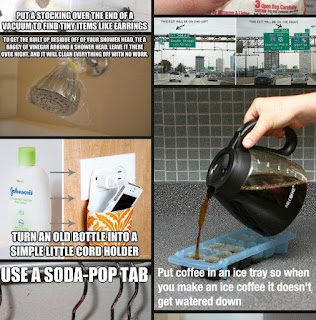
A number of these life hacks were useful on our recent move. For example, the orientation of exit number on a road sign indicating which side of the highway the ramp is on and a cell phone can be charged using the TV in a hotel. One of my favorites: make coffee iced cubes for iced coffee drinks. Brilliant! Click the picture for the full list.


Another post with great life hacks.

Our move, the legacy project, and advice from seniors


After deciding to pull up roots in TN and travel, a common conversation with co-workers and friends involved neglected travel opportunities of the past. Many of these conversations were toned with regret. Instead of traveling, they had taken a job in order to establish a financial base or maybe they hadn't traveled because they were waiting to travel with someone. Some of these people had put off traveling until their families were grown and more money was available. Many intended to travel after retirement.

The advice of older, more experienced , friends and family means a lot to me. Particularly, advice relating to  universal experiences like relationships, children, death, and finances. Almost every conversation about our decision to leave stable jobs for something new was positive and supportive. We were about to do something other people had wanted to do and hadn't.

Advice from the Legacy Project said the same. The Legacy Project asked 1200 elders the question: “Over the course of your life, what are the most important lessons you would like to pass on to younger people?” The results were compiled in the book 30 Lessons for Living. Here are three of the thirty lessons I found relevant to the move.

3.  Say “Yes” to Opportunities: When offered a new opportunity or challenge, you are much less likely to regret saying yes and more likely to regret turning it down. They suggest you take a risk and a leap of faith when opportunity knocks.

5. Travel More: Travel while you can, sacrificing other things if necessary to do so. Most people look back on their travel adventures (big and small) as highlights of their lives and regret not having traveled more. As one elder told me, “If you have to make a decision whether you want to remodel your kitchen or take a trip—well, I say, choose the trip!”

7. Time is of the essence: Live as though life is short—because it is. The point is not to be depressed by this knowledge but to act on it, making sure to do important things now. The older the respondent, the more likely they were to say that life goes by astonishingly quickly. Said one elder: “I wish I’d learned that in my thirties instead of in my sixties!”

FULL 10 HERE


Travel: Moving Statisitics

America on the move: biggest gainers and losers by state plus more. Click "read more" for image.

Thoughts on the Cluetrain Manifesto

The Cluetrain Manifesto and its 95 thesis, written in 1999, are worth a glance with or without my following commentary:

As a medium of communication and influence, the internet leads (think: recent events in Egypt. think: wikileaks). However, since 1999, corporations have "caught up" with the internet market; sluggishly at first, now at full speed. Using techniques taught in this class and elsewhere, corporations now know how to manipulate the new medium. Due to contrived positive/negative reviews, blogs, multiple web sites, viral campaigns, and other tactics of misinformation, it is often hard to tell what is legitimate information. The vision created in the manifesto is called into questions as the internet, not the corporation, bends (think of all the legislation since 1999 that has regulated the internet for corporate benefit).

These developments leave the Cluetrain Manifesto as an optimistic but irrelevant article in history-- a "could have been".  The manifesto is reduced to a model of good customer service for all but the most progressive company-- albeit, a good model. Customers are no longer impressed by size and professionalism. They want personal response and human interaction. Create customer dialogues appropriately. Scrap business jargon. Scrap form letters and scripted on-phone conversations for a touch of humanity and personality and the customer will respond.